Frederick Davenport Bates: Painter and Traveller
A Davenport history feature, written by Charlie Hulme
Davenport Station home | Index to History pages
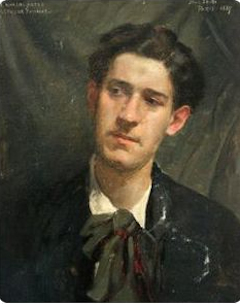
'Portrait of Frederick Davenport Bates' by Stephen Seymour Thomas (1868-1956), an American artist who was a fellow student of Bates at the Academie Julian.
Introduction
While working on our page about Davenport artist James Patchell Chettle, we contacted Stockport Council's collections manager, Bronwen Simpson, about Chettle works in Stockport's collection. She very kindly directed me to the Public Catalogue Foundation / BBC project to publish on the Web publicly-owned oil paintings, where several Chettles can now be viewed.
While browsing this superb resource, we came across the name of Frederick Davenport Bates, who painted three portraits of local citizens now owned by Stockport.
Investigating further, it transpired that the man's birth name was Frederick Bates, and he added the middle name Davenport, from the nearby area where where he lived and worked, and whose residents had sponsored his travels.
Very little has been written about him, although some of his works can be discovered through websites which record auction activities. However, by tracking his life on the Ancestry website it was possible to locate in Stockport Local Studies library a detailed obituary published in the Stockport Advertiser, and begin research.
Since originally creating this feature, additional information and references have been discovered, and also passed on by other admirers of Davenport Bates, and these have been incorporated into the text of this third version. Note that some information on other websites, notably his date of death, is incorrect.
Any further information about his life and work is very welcome.
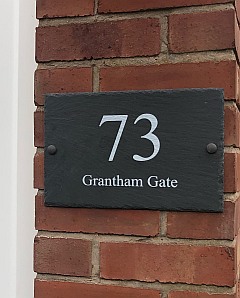
The original name of 73 Mile End Lane restored, 2021.
From the Stockport Express, May 28 1936
Thirty-eight years ago Mr. F. Davenport Bates, the Stockport artist, completed his first great picture "Christ or Barabbas" and many "Express" readers will remember the sensation it created when it was exhibited, and the manner in which Mr. Bates's achievement was praised by leading art critics of that time.
The great size of the picture, which measures 22ft. by 11ft. made it a matter of extreme difficulty to find a permanent home for it, and for years now it has been rolled up in the artist's studio, practically hidden away. The result is that a generation has sprung up which has had no opportunity of seeing a picture which is acknowledged to be a masterpiece.
Mr Frank Brown JP, a close personal friend of Mr. Bates, considered, however, that if the picture were once more publicly exhibited it would have a good effect on the public mind, bringing before the people the choice, which is theirs now quite as much as it was Pilate's in days of old, between Christ or Barabbas.
Mr. Brown accordingly purchased the picture, and after careful consideration and some investigation decided to present it to the Salvation Army in the hope that its message would assist the army in their 'World for God' campaign. The authorities of the Salvation Army promptly realised the value of such a striking representation of a historic scene as an auxiliary to their work, and gratefully accepted Mr. Brown’s generous offer. The formal presentation will take place on Monday, June 8, at the Star Hall, Ancoats, Manchester, when Mr. Brown will unveil the picture, which will be received by Commissioner Charles Rich on behalf of General Evangeline Booth. It will be on View in the hall on the three following days, and will then be removed to London.
Mr. Davenport Bates, the artist, is a native of Manchester, but was brought to Stockport when he was six months old, so with justice he is claimed as a Stockport artist. While he was studying art at Antwerp he was deeply impressed by Rubens’ masterly pictures of religious subjects, and he formed an ambition to paint a picture on an heroic scale.
In 1895 he made an extensive tour of the East, visiting among other places Palestine and Egypt, and the result was that he brought back a large number of sketches of Eastern people and scenes. He then set to work on the great picture of which the Salvation Army is now the fortunate possessor.
A number of Stockport people acted as models for Mr. Bates, among them the late Mr. T. Darman Ward who sat for Barabbas. Mr. Ward was an intimate friend of the artist, and as 'Geoffrey Penworth‘, wrote a brief biography of the artist, and also a graphic description of the picture. The biography concludes with the words: 'Genius can preach silent sermons, and the redeeming power of Christianity is advanced in the world when such painters as Davenport Bates can portray upon a dead canvas a living sermon which is capable of touching the heart of the most hardened disbeliever in the Divine Redeemer.'
The picture has been restored and retouched by Mr. Bates. and has been fitted with a collapsible frame which permits of its easy transit from one place to another. The exhibition of the painting may induce many who see it to visit Woodbank Park Museum to inspect Mr. Bates’s second great picture, 'The Passing of Christ.'
Grandpa and the Old Block
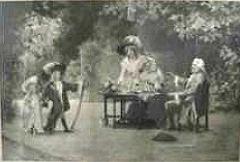
Two works by Bates which were published as reproductions appear to have sold well judging by the number of times they appear for sale today in various forms.
A note in the 'Art and Artists' column of the Manchester Courier of 28 March 1905 (p.9) reads:
'We have received from John Harrop Limited, of Dale-street, two excellent photogravures after pictures by F.Davenport Bates. The subjects are "A Chip off the Old Block" and "A Visit to Grandpa", and both are likely to be popular.'
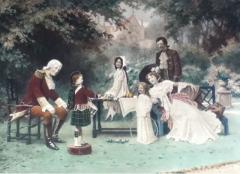
The prints appeared in framed editions; all the ones we know of are (or have been) incorporated in an overmantel with mirrors, as shown below; this example was for sale in 2013.
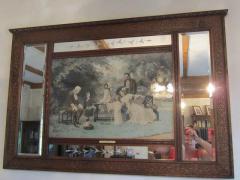
John Harrop Ltd, 'basinette manufacturers and furniture dealers' had a workshop in Bury Street Mills, Heaton Norris and a retail shop at 48-50 Lower Hillgate, Stockport as well as their wholesale premises at 27 Dale Street, Manchester. John Harrop himself served as Lord Mayor of Manchester in 1906 and 1907.
The Romance of a Musical Bachelor
Mr Bates provided the illustrations for a fascinating little book entitled The Romance of a Musical Bachelor and other stories: a series of sketches from the Cheshire Highlands published in 1898 by Simpkin, Marshall & Co, and in a second edition in Manchester by John Heywood. The author is Geoffrey Penworth, the pen-name of Frederick's friend Thomas Darman Ward.
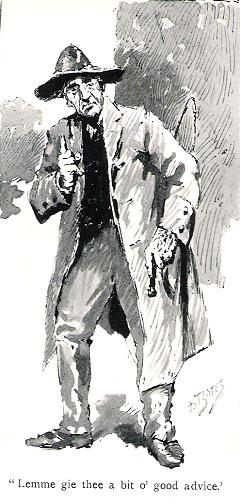
The stories are set in the fictional village of 'Stillmere' which is somewhere in the hills between Stockport and Macclesfield between the textile towns and the Cheshire plain - an area very familiar and dear to the heart of the author of this website. Charming little vignettes of Cheshire life, accompanied by charming little Bates watercolour sketches reproduced in black and white.
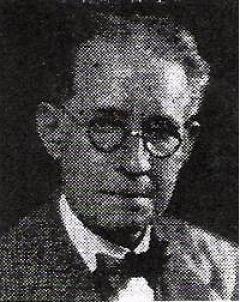
Bates in later life.
From the Stockport Advertiser, 1943
From the Stockport Advertiser, 1943
Works by Frederick Davenport Bates
A list, in no exact order, of works by Bates, based on our research and correspondence to this site. Titles may be inaccurate; assumed to be oil on canvas unless otherwise noted. * indicates works illustrated in the main text.
Pandora
Market scene, Antwerp (1889)
For Pity's Sake
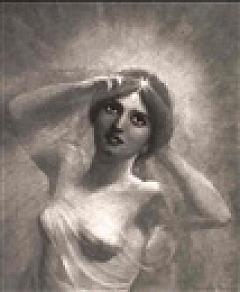
Birth of the Rainbow (c.1898)
Cast Adrift
View of old houses in (?) Interlaken (1892)
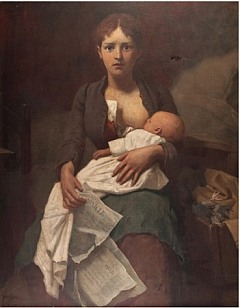
A Soldier's Legacy (1899 -
published as engraving)
Shopping in Cairo
A Soudanse street seller, Cairo
Mine Host (1897) *
Maltese idlers
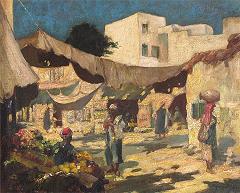
North African Market scene
Constantinople *
Feluccas on the Nile
Head of a man in a turban
Christ or Barabbas (1896-9) *
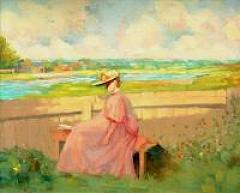
Young Girl on garden bench (1896)
Afternoon in the Garden *
The passing of Christ (1900) *
A Chip off the Old Block (1903 -
published as photogravure print)
A visit to grandpa (1903 -
published as photogravure print)'
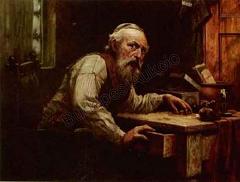
'Disturbed'
Tailor in his workshop
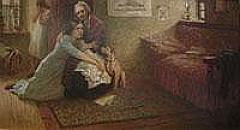
Sorrow of War
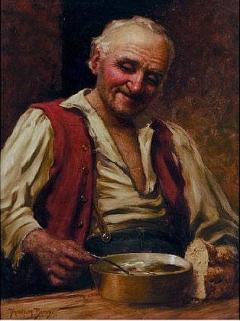
At the end of the day
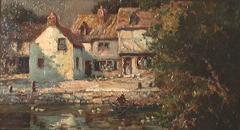
Flower seller by the river
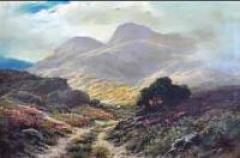
Sheep grazing in a Highland Landscape
Marple (also known as A River Town) See the page heading *
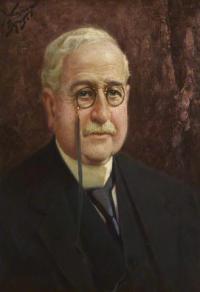
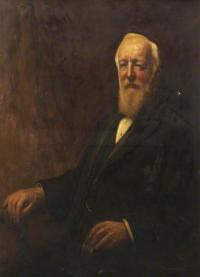
Portrait of James Horner, of Stockport Cricket Club and Treasurer of Lancashire C.C.
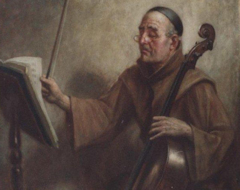
Monk playing a violoncello.
Credits
Thanks to everyone who has helped, consciously or otherwise, with the creation of this feature, especially the current residents of 73 Mile End Lane; the Clucas family; Margaret Hughes (who sadly passed away in 2017); John Cardwell; Peter Tyler; Steven Spencer of the Salvation Army; the staff of the Libraries of Stockport and Bramhall; and Angela Nesic of Stockport Council's curatorial service.
Any copyright holder objecting to the use of an image on this page should contact us and it will be removed.
Contributions are very welcome at at info@davenportstation.org.uk
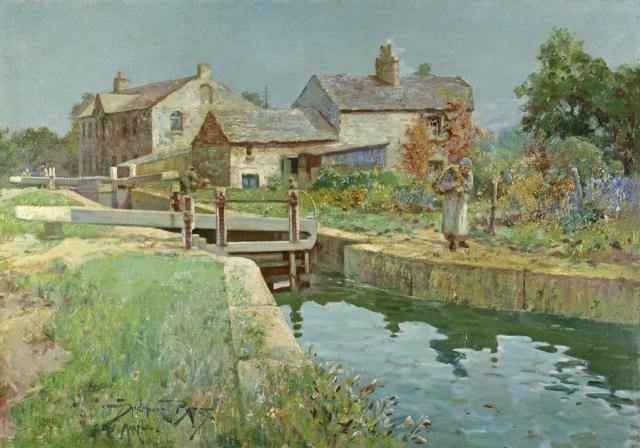
'Marple'
Frederick Bates was born in Chorlton-on-Medlock, Manchester in 1867. His father was Peter Bates, at that time a corn dealer; his mother Mary was born Mary Rawstron in Stockport. Peter Bates gave his birthplace as 'Furness, Cheshire' - the village now known as Furness Vale, now part of the High Peak district of Derbyshire.
Frederick was the youngest of the family; he had four older sisters, Annie, Mary, Emily and Elizabeth (later known as Lilly or Lily). In the 1850s the family had lived in Stockport, and soon after Frederick's birth they moved back there, settling at 33 Thomson Street, near the Infirmary, by 1871. By this time Peter had progressed from corn dealer to accountant: an 1874 directory lists him as 'accountant, house, land and commission agent' with an office at 12 Vernon Street and a home at 94 Wellington Road South, Stockport. Peter died in 1880; the family remained in the small house at no. 94, three doors down from the Nelson Tavern. (The house longer exists, a modern building stands on the site.)
On leaving school Frederick served an apprenticeship as a draughtsman with Hetherington & Sons, engineers, of Vulcan, Phoenix and Ancoats Works, Manchester, makers of machine tools and textile machinery, where he learned to draw accurately, and was encouraged in amateur artistic efforts by John Muir Hetherington (1833-1908), son of the founder and a partner in the firm. Having served his time, aged 21 he decided to forego engineering for a career as an artist.
Travels
The 1891 census lists Mary Bates, 'living on own means' with Emily (aged 32), Mary jr. (aged 35), and Elizabeth (entered as Lily, aged 26) at 62 Bramhall Lane in Cale Green. Frederick does not feature in the 1891 census at all: he was away following his ambition. At the age of 16 he had exhibited a painting at Manchester Art Gallery, and as soon as he could, perhaps with the help of an inheritance from his father, he was off to Paris to learn the painter's trade in the 'ateliers of the "Boul Mich"' - the Boulevard St.Michel. He became a student at the Academie Julian - an independent school no entrance exams and with nominal fees - where he was taught by Adolphe William Bouguereau, Tony Robert-Fleury, and Gabriel Ferrier.
He then moved to Antwerp where, under the influence of the Flemish tradition, he developed the ideas for his religious paintings. He won a prize of the Belgian Academy of Fine Arts, entitling him to the use of a studio and a choice of two professors from the Academy as tutors. He chose Albrecht de Vriendt, who was court painter to King Leopold, and Pierre Jan Van de Ouderaa, with a view to becoming a portrait specialist.
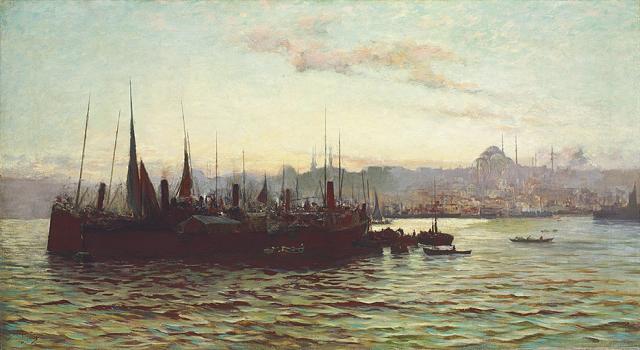
'Constantinople'
(c.1896)
83.8
x
152.4
cm
In 1895 he travelled to the Middle East, North Africa and the Holy Land, reportedly accompanied by John Foster Fraser (1868 - 1936), a journalist and traveller who wrote some remarkable books, including Round the World on a Wheel (1899) an account of a round the world cycling journey with two friends. Bates does not feature in this or other Fraser books, but he did illustrate some of Fraser's magazine articles. He made many sketches on his journeys which he later worked up into large oils, such as the spectacular view (above) of 'Constantinople', painted in 1896, which measures five feet across, and sold at auction in 2008 for £49,250, and his first great religious painting 'Christ or Barabbas', described in a separate section below.
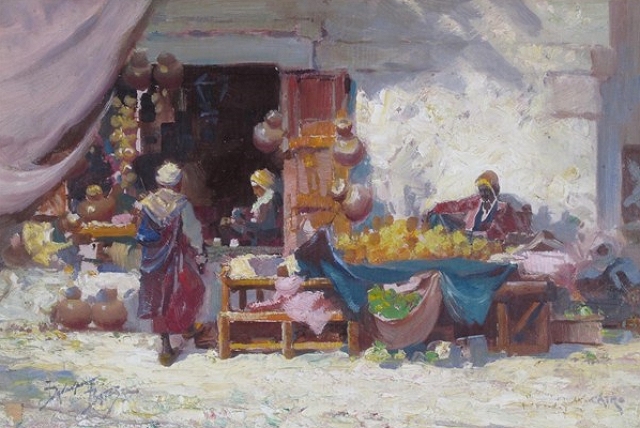
'Shopping in Cairo' ,
Oil on board, 29 x 44cm
In early 1899 Frederick married Catherine Grantham Shepherd, daughter of a Mechanical Engineer, James Shepherd, of 'Shirdfold', The Crescent, Davenport, and his wife Elizabeth. They set up home at 9 Mile End Lane, on the other side of the main Manchester - Buxton road from the main part of Davenport, which they named 'Grantham Gate' after Catherine's middle name which was her mother's maiden name. For more about the Shepherd family, see our James Shepherd feature.
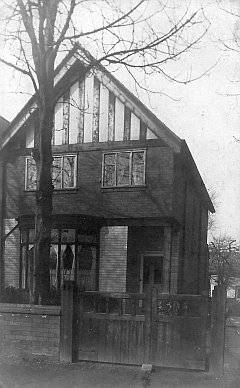 By 1910
they had moved further up the lane to no. 73 which then
became 'Grantham Gate.' Both houses date from the
1890s. Could 'Afternoon in the Garden' have been painted
there? The 1901 and 1911 census records that the family had
a live-in servant, Alice James; the image of
no.73 reproduced here is from a postcard posted by her to
her sister in Birkenhead.
By 1910
they had moved further up the lane to no. 73 which then
became 'Grantham Gate.' Both houses date from the
1890s. Could 'Afternoon in the Garden' have been painted
there? The 1901 and 1911 census records that the family had
a live-in servant, Alice James; the image of
no.73 reproduced here is from a postcard posted by her to
her sister in Birkenhead.Frederick and Catherine had one child, Lilian Khadder Bates, born in 1900; her unusual middle name seems to be connected in some way with Frederick's travels in North Africa. In 1924 she married Frank A. Beal (born c. 1895), a son of Arnold J. Beal, partner in the fim of J. J. Beal and Sons of Sheffield who were engaged in that city's iconic cutlery industry, manufacturing 'edge tools' such as knives and razors. The 1939 register records them in the rural surroundings of Sheffield with three servants in a large house, 'Rivelin Lodge', which survives today.
Away from his painting, Frederick was one of he founders of the Stockport Literary Club, and had a keen interest in the work of the Stockport Lads' Club.
In 1899 he persuaded a consortium of wealthy Stockport businessmen, perhaps led by his new father-in-law James Shepherd, to finance a second expedition to the Holy Land - perhaps also serving as honeymoon. The legend is that on his return, he repaid them with pictures. One member of the consortium who financed the trip was shipping merchant W.E. Clucas of 'Reinbek' (see our feature 'The Reinbek Story') and three pictures remain with his descendants. The outcome of the trip was his second great work, 'The Passing of Christ': see 'Great Religious Works' below for their stories.
Frederick Bates was more than just a painter of portraits and religious scenes, however. He also turned his hand to popular landscape works such as the pleasant study of Marple Locks seen above. His 1901 census entry mentions 'sculptor' as well as 'painter' - but we have not been able to discover records of any sculptures. He created many paintings in a wide range of genres, in his career, but appears to be have been ignored by the curators of public galleries, at least as far as oil paintings are concerned. The 'Your Paintings' project, which aims to show the entire UK national collection of oil paintings, and lists 212,145 entries, records only the three portraits in Stockport, none of which are on display.
An feature on Bates in Vol. 11 (1899-1900, p.77-78) of the periodical Manchester Faces and Places, attached to a review of 'Christ or Barabbas' gives some clues, in the following extract which also gives an idea of the typical writing style of such pieces:
In 1895 he visited Egypt and
Palestine, where he obtained studes of Eastern life and
customs for realisation of his great ambition, and this
subsequently extended his journeyings to countries visited
by the disciples, including the ports of the Black Sea,
the islands of the Mediterranean, and back through
Northern Africa to Europe. In Cairo, he painted "For
Pity's Sake", which brings out in fine relief the higher
workings of a refined artistic nature. The scene is an
Eastern one, and as an authority has put it "no one can
give it thoughtful attention without having it borne into
the mind that this is a work of no ordinary merit, in that
it possesses in no small degree the distinguishing
attribute of the soul." Last year, Mr. Bates
exhibited his "Birth of the Rainbow", which evoked
favourable criticism as an ambitious and really serious
work, deserving of respect and 'conveying about the head a
curious suggestion of Sir Thomas Lawrence, as in his
diploma picture at Burlington House'.
In 1896 he elaborated his Eastern studies, and the result we have before us in "Christ or Barabbas". This, up to the present time, but there are many minor works (if we can use such an expression for such artistic productions), notably Pandora, exhibited at the Royal Academy, Antwerp, and "Cast Adrift" which was painted for the Royal International Exhibition, Antwerp, 1893, in response to a special invitation issued by the Council of the Exhibition. His most recent effort is a "Soldier's Legacy", which again shows him at his best in the pathetic. It is a small canvas, and sets forth the grief-stricken widow with the unconscious babe on her knee. It has been acquired by a well-known firm of newspaper proprietors, and has been engraved, copies being disposed of in aid of the South African war fund. Mr. Bates is at present in Palestine making further studies for another great picture, and his numerous friends, both in Manchester and elsewhere, will wish him health and strength to further consummate a noble and laudable ambition, which will tend to strengthen our powers of thought and observation, lift up the mind, through Art up to Nature and thereby to Nature's God.
In 1896 he elaborated his Eastern studies, and the result we have before us in "Christ or Barabbas". This, up to the present time, but there are many minor works (if we can use such an expression for such artistic productions), notably Pandora, exhibited at the Royal Academy, Antwerp, and "Cast Adrift" which was painted for the Royal International Exhibition, Antwerp, 1893, in response to a special invitation issued by the Council of the Exhibition. His most recent effort is a "Soldier's Legacy", which again shows him at his best in the pathetic. It is a small canvas, and sets forth the grief-stricken widow with the unconscious babe on her knee. It has been acquired by a well-known firm of newspaper proprietors, and has been engraved, copies being disposed of in aid of the South African war fund. Mr. Bates is at present in Palestine making further studies for another great picture, and his numerous friends, both in Manchester and elsewhere, will wish him health and strength to further consummate a noble and laudable ambition, which will tend to strengthen our powers of thought and observation, lift up the mind, through Art up to Nature and thereby to Nature's God.
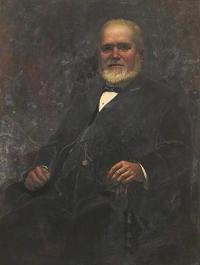
Known portraits by Bates include William Lees (see left), Frank Brown (left), Judge Leigh, (painted to mark the Judge's jubilee as a teacher of the Stockport Sunday School), Mr William B. Leigh, Mr J.A. Fletcher, formerly secretary of the Stockport Lads' Club, and Mr James Horner, of Stockport Cricket Club. One of his last subjects was Mr William Crossley of the Stockport Sunday School.
Last years
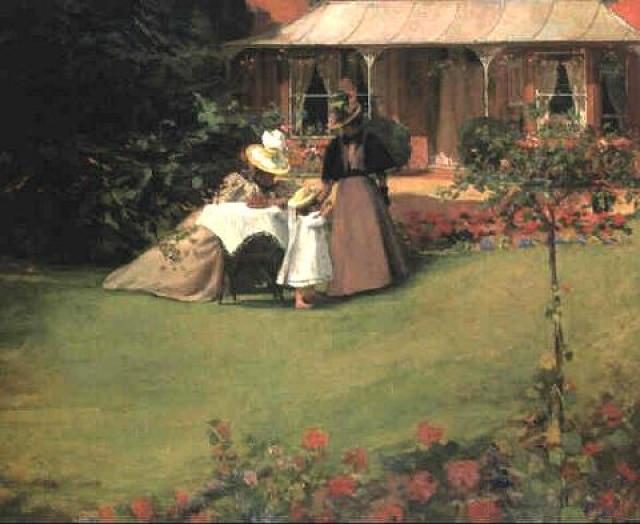
'Afternoon in the Garden'.
This work sold for $13,500 at an auction in New York in
1985.
After two years' illness, Frederick Davenport Bates died at his home, 73 Mile End Lane, in the early hours of 17 July 1943 (contrary to several sources which give his dates as 1867-1930). Among those in attendance at Stockport crematorium was Mrs W.E. Clucas, the wife of W.E. Clucas who may have been too ill to attend as he too died soon afterwards. Catherine Grantham Bates died in 1947.
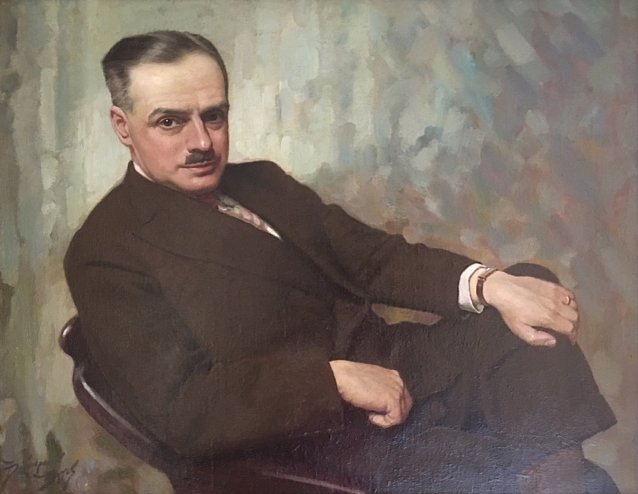
The eye-catching portrait above is of Dr F.J. Kitt of Stockport, a local general practitioner. It is signed 'Davenport Bates 1940', perhaps one of Frederick's last works as there was surely little demand for paintings in wartime. Dr Kitt's grandson, the owner of the work, understands that it was painted in lieu of medical fees in those times before the National Health Service; his artistic work did not make Frederick a wealthy man. By that time, there was no domestic servant, except that the couple had been joined by Frederick's unmarried sister Elizabeth, who had previously lived with her sister Emily Bates at 26 Oakfield Road, Davenport.
Described in his obituary (Stockport Advertiser, 23 July 1943) as a 'well-known local artist', Davenport Bates' life and work now appear to have been forgotten in the place where he lived for over 75 years: perhaps this article will go some way towards bringing him back to local attention.
The Great Religious Works
As mentioned above Davenport Bates created two very large-scale religious works with his friends and relations acting as models. Their stories,as we have pieced them together, are as follows. Both works were very large, approximately 22 ft by 11 feet, and were initially placed on public display at various sites as a paid attraction.
Christ or Barabbas
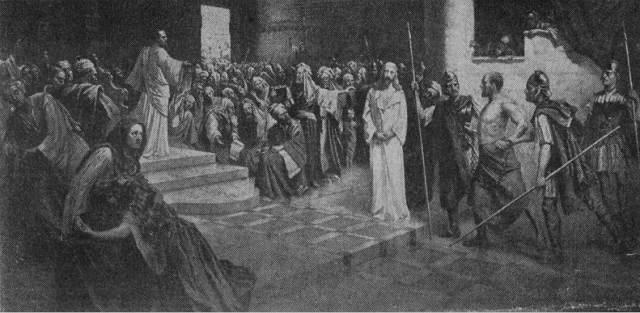
Bates conceived his large religious epics while studying in Antwerp in 1889, where he saw in the Cathedral the Peter Paul Rubens triptychs 'The Elevation of the Cross' and 'The Descent from the Cross' painted in 1610-14. He began work on 'Christ of Barabbas' in 1896 on his return from his Middle East journeyings. It portrays the New Testament story of the trial of Christ before Pontius Pilate, Roman Governor, in Jerusalem. Pilate offered to the mob the release of Jesus or the notable criminal Barabbas.
The following is from Chapter 27 of the Gospel according to Matthew (King James Version):
Now at that feast the
governor was wont to release unto the people a prisoner,
whom they would. And they had then a notable prisoner,
called Barab'bas. Therefore when they were gathered
together, Pilate said unto them, Whom will ye that I
release unto you? Barab'bas, or Jesus which is called
Christ? For he knew that for envy they had delivered him.
When he was set down on the judgement seat, his wife sent unto him, saying, Have thou nothing to do with that just man: for I have suffered many things this day in a dream because of him. But the chief priests and elders persuaded the multitude that they should ask Barab'bas, and destroy Jesus. The governor answered and said unto them, Whether of the twain will ye that I release unto you? They said, Barab'bas.
Pilate saith unto them, What shall I do then with Jesus which is called Christ? They all say unto him, Let him be crucified. And the governor said, Why, what evil hath he done? But they cried out the more, saying, Let him be crucified.
When Pilate saw that he could prevail nothing, but that rather a tumult was made, he took water, and washed his hands before the multitude, saying, I am innocent of the blood of this just person: see ye to it. Then answered all the people, and said, His blood be on us, and on our children. Then released he Barab'bas unto them: and when he had scourged Jesus, he delivered him to be crucified.
When he was set down on the judgement seat, his wife sent unto him, saying, Have thou nothing to do with that just man: for I have suffered many things this day in a dream because of him. But the chief priests and elders persuaded the multitude that they should ask Barab'bas, and destroy Jesus. The governor answered and said unto them, Whether of the twain will ye that I release unto you? They said, Barab'bas.
Pilate saith unto them, What shall I do then with Jesus which is called Christ? They all say unto him, Let him be crucified. And the governor said, Why, what evil hath he done? But they cried out the more, saying, Let him be crucified.
When Pilate saw that he could prevail nothing, but that rather a tumult was made, he took water, and washed his hands before the multitude, saying, I am innocent of the blood of this just person: see ye to it. Then answered all the people, and said, His blood be on us, and on our children. Then released he Barab'bas unto them: and when he had scourged Jesus, he delivered him to be crucified.
Thus developed one of the essential tenets of Christianity, the death of Jesus Christ which impression that all the people involved are acting out a predetermined course of action.
Bates used his friends and associates as models for the people in the picture: Barabbas is said to be a portrait of Thomas Darman Ward, musician, art critic and fellow member of the Stockport Literary Club, who also co-operated with Bates on other projects, sometimes under the pen-name Geoffrey Penworth.
Many column-inches were expended in various periodicals in reviewing and interpreting the picture, often in glowing terms: the following, from the Manchester Guardian, (12 April 1900, page 7) takes a more measured approach:
"CHRIST OR BARABBAS".- Mr.
Frederick Davenport Bates, an associate member of the
Manchester Academy of Fine Arts, is exhibiting at the
Free-trade Hall a huge canvas entitled "Christ or
Barabbas." It is rare to find an English artist bold
enough to work out such a theme on the colossal scale
adopted by many foreign painters, such as Gustave Doré and
Munkácsy, and it says much for this young Manchester
artist's ardour and perseverance that he should have made
the attempt to rival such works as Munkácsy's 'Ecce Homo.'
That it would be a complete success was not to be expected; even Munkácsy, with all his enthusiasm and long experience, failed to make his vast realistic compositions really impressive and overwhelming in the sense in which Rembrandt's "Night Watch" impresses and overwhelms the spectator by its grandeur as a whole and sustained brilliance of execution in detail. But Mr. Bates's big picture, which is nearly as large as the "Ecce Homo" that was shown here some time ago, has, nevertheless, considerable merit. It is painted in a bold, free dashing style, as if the artist grasped his composition as a whole and knew what he wanted to do. There are no signs of hesitation, no unnecessary elaboration of details to mar the general effect. The crowd of priests and fanatics shouting for Barabbas is animated and lifelike, and the chief figures, Christ, Barabbas, Pilate, and Caiphas, though somewhat melodramatically conceived, are not wanting in dignity.
The scheme of colour, in which dull reds and and greys are contrasted with the warm, creamy hues of Pilate's marble throne, is sombre but not unpleasing, and is agreeably relieved by the view of Jerusalem in bright sunlight which is seen through the open doorway in the centre of the rather gloomy hall. The picture is not well composed: the crowd - the main centre of interest - is pressed into the top left-hand corner, and foreground is left practically empty. The artist has attempted to impart some interest to the foreground by introducing two figures of women, for the mother of Christ and the Magdalen, but, technically speaking, these two figures upset the balance of the composition.
Besides, it is not easy to understand why Christ should stand with his back to the crowd, or why Pilate should have allowed the people to crowd into his hall of judgement by a side door behind his throne; the conventional arrangement would have been simpler and, we think, more satisfactory. But these are faults due to inexperience. The picture, will all its failings, is a considerable performance and contains the promise of better things.
Mihály Munkácsy (1844-1900) was a contemporary of Bates, a
Hungarian painter whose three large religious works, "Christ
before Pilate" (1882), "Golgota" (1884), and "Ecce Homo"
(1896) - known together as "The Trilogy" - have
survived to be displayed
together in the Déri Museum in the Hungarian city of
Debrecen. He died on 1 May 1900. That it would be a complete success was not to be expected; even Munkácsy, with all his enthusiasm and long experience, failed to make his vast realistic compositions really impressive and overwhelming in the sense in which Rembrandt's "Night Watch" impresses and overwhelms the spectator by its grandeur as a whole and sustained brilliance of execution in detail. But Mr. Bates's big picture, which is nearly as large as the "Ecce Homo" that was shown here some time ago, has, nevertheless, considerable merit. It is painted in a bold, free dashing style, as if the artist grasped his composition as a whole and knew what he wanted to do. There are no signs of hesitation, no unnecessary elaboration of details to mar the general effect. The crowd of priests and fanatics shouting for Barabbas is animated and lifelike, and the chief figures, Christ, Barabbas, Pilate, and Caiphas, though somewhat melodramatically conceived, are not wanting in dignity.
The scheme of colour, in which dull reds and and greys are contrasted with the warm, creamy hues of Pilate's marble throne, is sombre but not unpleasing, and is agreeably relieved by the view of Jerusalem in bright sunlight which is seen through the open doorway in the centre of the rather gloomy hall. The picture is not well composed: the crowd - the main centre of interest - is pressed into the top left-hand corner, and foreground is left practically empty. The artist has attempted to impart some interest to the foreground by introducing two figures of women, for the mother of Christ and the Magdalen, but, technically speaking, these two figures upset the balance of the composition.
Besides, it is not easy to understand why Christ should stand with his back to the crowd, or why Pilate should have allowed the people to crowd into his hall of judgement by a side door behind his throne; the conventional arrangement would have been simpler and, we think, more satisfactory. But these are faults due to inexperience. The picture, will all its failings, is a considerable performance and contains the promise of better things.
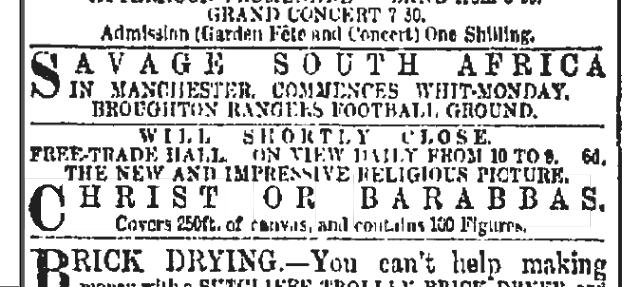
The classified advert from the Manchester Guardian, 24 May 1900, reveals the admission price of six (old) pence. '250ft. of canvas' sounds extremely impressive, but correctly should be '250 square feet'. Incidentally 'Savage South Africa' refers to a theatrical event featuring a troupe of Zulus which toured the country as the Boer War raged in South Africa. A film clip survives.
Following its short period of fame, 'Christ or Barabbas' was reportedly rolled up and stored in Bates's studio, where it remained for many years until purchased by Mr Frank Brown J.P. (a friend of Bates and the subject of a portrait) who was the owner, or a director, of the Bob Bon (John Horn) confectionery works in Canada Street, Heaviley, and served on Stockport Borough Council. Mr Brown's intention was to present the picture to the Salvation Army, and after some restoration by the artist, it was formally presented to that organisation on 8 June 1936 at the Star Hall, Ancoats.
The painting was received by Commissioner Charles Rich of behalf of General Evangeline Booth, and it was planned to remain at Star Hall for three days before being transferred to London. Under the Salvation Army's auspices it went on tour: a note in The Times for 11 September 1936 records it 'on free view' at the Sion College, Victoria Embankment, London, and to be moved the following day to the Congress Hall, Linscott Road, Clapton for a week, and would later visit other Salvation Army Halls in London. The photograph reproduced here is from the Stockport Express of 28 May 1936; sadly, a colour reproduction of the work is unlikely to exist.
In December 1936, Frank Brown died, and is buried in Stockport Cemetery. Stockport's Local History Library wrote to the Salvation Army in 1981 enquiring about the painting, and was told that it
... hung for some time in our Clapton Congress Hall, facing the platform at the far end, and was still hanging there in 1973. We are assured that the picture was removed and brought here to an International Headquarters storeroom. We are not quite sure exactly which room it is in but we have someone looking into this matter and will inform you in due course.Unfortunately it seems that there was no further correspondence at that time. The Congress Hall building was sold, and mostly demolished in the 1970s; its classical portico remains as part of a school. The Salvation Army moved to the much smaller Clapton Congress Hall at 122 Lower Clapton Road.
Enquiries to the Salvation Army archivist in 2014 suggest that although there are memories of the painting stored at the Congress Hall rolled up in its travelling case, nobody can now be found who knows what happened to it after the hall was vacated.
The Passing of Christ
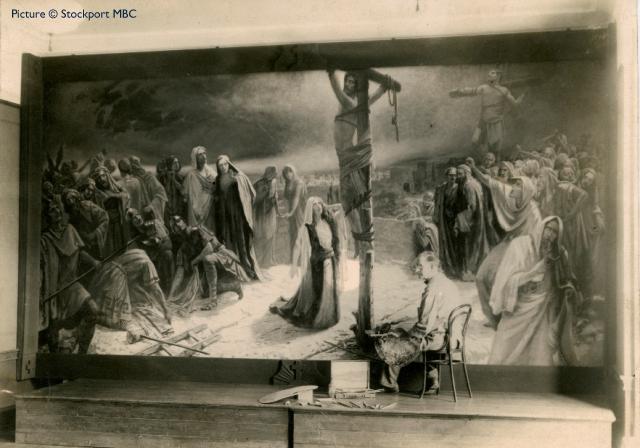
As a follow-up to 'Christ or Barabbas', Bates embarked on a second large work, again 22 feet by 11 feet, 'The Passing of Christ.' The above picture, copyright of Stockport Council, shows Bates in what is probably a posed view in front of the completed work, mounted in its special carrying frame.
The scene is the crucifixion on Jesus Christ on the hill of Golgotha. From the Gospel of Matthew Chapter 27:
And they crucified him, and
parted his garments, casting lots: that it might be
fulfilled which was spoken by the prophet, They parted my
garments among them, and upon my vesture did they cast
lots. And sitting down they watched him there; And set up
over his head his accusation written, THIS IS JESUS THE
KING OF THE JEWS. Then were there two thieves crucified
with him, one on the right hand, and another on the left.
And they that passed by reviled him, wagging their heads,
And saying, Thou that destroyest the temple, and buildest
it in three days, save thyself. If thou be the Son of God,
come down from the cross.
The soldiers on the left appear to be preparing the sign to place above his head.
'The Passing of Christ' was purchased by a syndicate (possibly the same Stockport businessmen who had sponsored the tour of the Middle East) and was shown around 'most of the cities and towns of the country' with an explanatory 24-page booklet, written by Thomas Darman Ward, on sale to visitors. At least one copy of this booklet survives, but we have yet to arrange a viewing.
After the tour it was sold to Samuel Rigby, of 'Bramall Mount', the large house which still stands in 2021 on Bramhall Lane, Davenport next to Cale Green Park. He is said to have hung it in his warehouse at the Spring Bank Mill, Wellington Road South, before presenting it in 1934 to Stockport Corporation, who, according to the newspaper obituary, displayed it in Woodbank Hall. The Hall, along with its surrounding park, had been given to Stockport in the early 1920s by Sir Thomas Rowbotham. After standing empty for some time, in 1931 the Hall was opened to the public as a "Museum of Rural Life & Fine Art" with reading room, lecture room and tea room. This lasted only until 1948, however, and the Hall is now used by Stockport Council as offices, having been under threat of sale to private developers.
The painting is believed to exists, rolled up in its travelling case, in a Stockport Council store. It is now considered that to unroll it would cause damage, and for this reason it was not included in the 'Your Paintings' project which aimed to photograph and display on the web every painting in a British public collection. Its keepers inform us that restoration of the work would be very expensive, well beyond any funds available to Stockport Council, so unless a multi-millionaire benefactor is inspired by this article, it will never see the light of day again.
Postscript: Woodbank Hall
In 1994, a letter was published in Stockport Heritage magazine (Vol.3 No.3, p.16) from a Miss D.K. Bridge including a reminiscence of the 1930s:
I remember at Easter time my
father used to take us to Woodbank Museum where people
were queueing to see the paintings. We had to stay behind
a barrier of chairs and all the men removed their hats. I
remember there were two large paintings, each practically
covering one wall, and I think one was titled "Golgotha".
Whatever happened to these paintings?
This strongly suggests that both 'Christ or Barabbas' and 'The Passing of Christ' were on show in Woodbank Hall: this must have been after 'The Passing of Christ' was presented to the Council in 1934, and perhaps after 'Christ or Barabbas' has been purchased by Mr Brown and restored by Bates.
The article 'A Picture Puzzle', by Margaret Hughes, in a later Stockport Heritage (Vol.5, no.9, 2004, p. 40-41), possibly the only published article about Bates in modern times, mentions her father, who had bought a Bates landscape for half-a-crown in a Shaw Heath 'junk shop', and later enquiring at Woodbank Hall and being shown the painting of the crucifixion stored in the cellar.
Mrs Hughes later inherited her father's painting and made enquires about Bates and his career; she published letters in the local press asking for information, but with little response. Stockport Council staff kindly carried out some research for her, discovering some of the facts. Today we have the resources of the Internet at our disposal, but her questions are still appropriate: does anyone, in Stockport or elsewhere, own any Bates works or other information they would be willing to share?
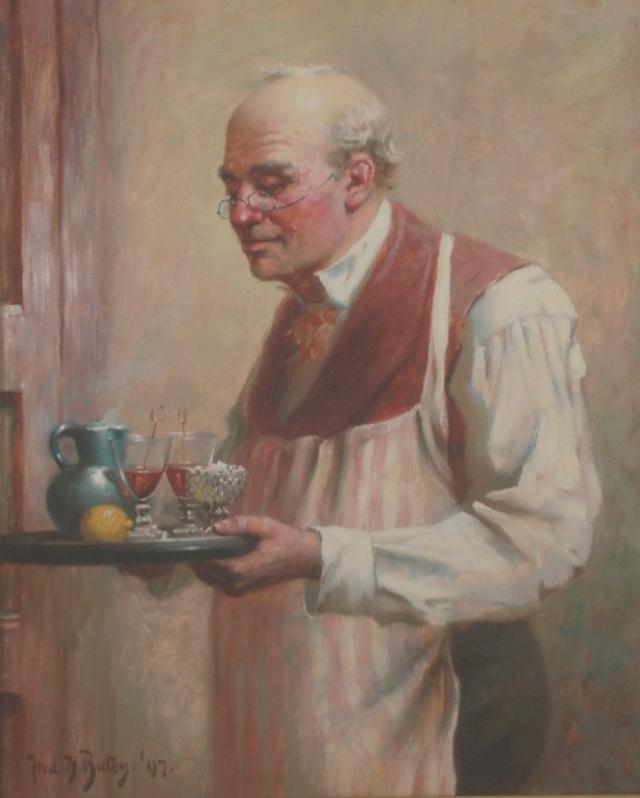
'Mine Host' (1897)
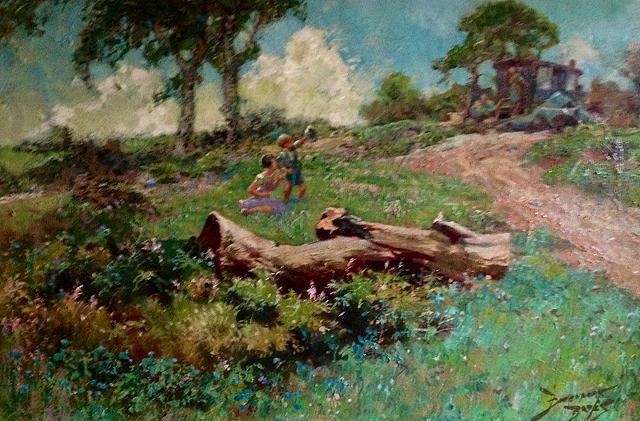
Children and Gypsy Caravan (c.1902)
Children and Gypsy Caravan (c.1902)
Written by Charlie Hulme, October 2011. Updated August 2021.
Comments welcome at info@davenportstation.org.uk