Davenport Railway Station: Local History
Home | Live departures | Journey Planner | Train Services | Streetmap | Local History | Links
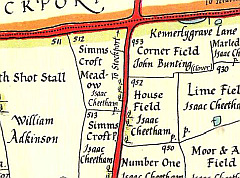
Download our 32-page illustrated booklet on the history of Davenport published in 2007 (2.8MB PDF)
Our Document Archive of Stockport directories, etc.
Gallery: Archive of our own local history images.
The J.W. Sutherland Photographic collection. Includes many pictures of local railway scenes.
Davenport, a residential suburb which lies on the outskirts of the town of Stockport in Greater Manchester, takes its name from its railway station, itself named after the Davenport family which for centuries lived at Bramall Hall. When the railway came to the area in the 1850s in the shape of the Stockport, Disley and Whaley Bridge line, there was no settlement here; it was just a remote corner of the Davenport family's estate. However, the Davenports had ideas of developing this part of their land as a residential suburb.
The station was built at the point where the Stockport to Bramhall road, believed by some to be a Roman Road, crossed the railway; the station was not actually built in time for the opening of the line in 1857, but the following year, 1858 after complaints from the Davenports that a station had been promised, as small station was built. It was named Davenport after its sponsors. Not long afterwards, however, the Davenports sold all their land, including what is now Davenport, much of it to a property company, and moved away from the area. A few large houses were constructed around the station in its early years, several of them to be occupied by moguls of the hatting and cotton-spinning industries for which Stockport is famous.
Between 1880 and 1914, much building development created the village of Davenport as we know it, including the row of shops (originally built as houses) along Bramhall Lane south of the station, and the main shopping area we now know as 'Davenport Village' although this does not fall within the original definition of Davenport, which referred only to the area south of Kennerley Road. As the map shows, the boundary between Bramhall and Stockport followed Kennerley Road and the old route of Garner's Lane, and development on the Stockport side was of a more industrial and commercial character with smaller houses, while larger homes for the wealthier citizen, including the private housing estate of Davenport Park, continued to dominate the Bramhall side.
In 1901, the boundary was changed to follow the Midland Railway railway line (then under construction) nearer to Bramhall, the new line becoming the border between Stockport County Borough and the Hazel Grove and Bramhall Urban District. Since 1974 both have been part of Stockport. From the 1920s onwards, there was more housing development in the area which had become part of Stockport, and after World War II a new phase began with the demolition of a number of the original large houses, to be replaced by flats and smaller houses. This process continues today, with homes being built on any land which becomes available. Fortunately, however, some areas of open land still survive.
Contributions, comments and suggestions are very welcome.
davenport@nwrail.org.uk
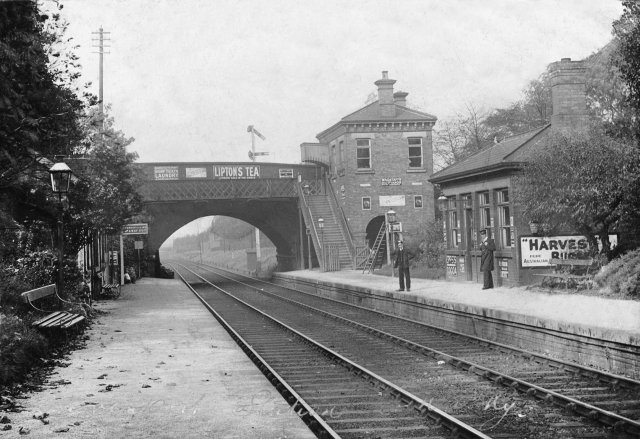
Davenport station, c. 1910.
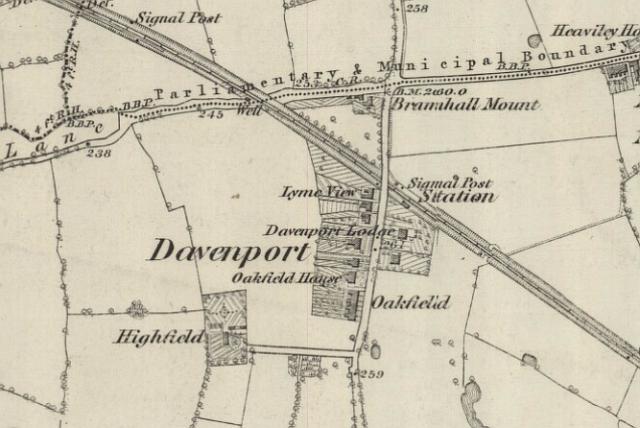
The map above shows the village as it was in the 1870s.
Local History
feature collection
| 1. Old and
new homes Davenport's oldest and newest
buildings examined (2006) 2. Davenport Junction and The Khyber A lost railway route (2006- comprehensive update 2021) 3. Who was Winifred? The story behind some street names (2014, updated 2022) 4. Postcard from Davenport: Bramhall Lane and Frewland Avenue (2014) 5.A postcard from Oberhofen: researching a house on The Crescent (2012) 6. Postcard: Bramhall Lane South: over the border. The life and times of Mrs Jepson (2011) 7. Postcard from Davenport: as seen from the bridge, including the story of Bramall Mount (2009-11) 8. Postcard from Davenport: a view on Bramhall Lane (2007) 9. The account book of 'The Alders', The Crescent, 1899-1917 (2009-12) 10. James Patchell Chettle, 1871-1944: Davenport artist (2011-2) 11. The Reinbek story: last of the big houses to be built, now a care home (2011-3) 12. Frederick Davenport Bates: artist who adopted the name (2011) 13. Early Days at Davenport: from 1858, including the lives of the first three station masters (2011) 14. Bullock Brothers, Photogaphers (2012) 15. Beaconsfield and the Mormon Church: A lost mansion, a family story and a modern church. (2013) 16. Jesse Lumb and the Crescent: a Yorkshire mill owner's investment (2013-4) 17. Bamford Grange: a house in Adswood and its past residents (2014) 18. A Tram on the A6, and other stories: transport then and now, with the story of some Buxton Road houses and their residents (2014). 19. James Shepherd, Shird Fold and the Power Pulley: stories of a Davenport house and its families (2014- updated 2020). 20. Ephraim Hallam's legacy: Some Davenport shops and their neighbours (2015 - revised and updated 2021) 21. Postcard from Davenport: Belthorn, Davenport Park Road (2015) 22. Davenport Post Office: a century of service (2016) 23. John Williams & Sons: A Davenport family with a chain of grocery shops (2017, updated 2020) |
24. Tasmania
Cottage and its neighbours: some tales of
Adswood Lane West (2017) 25. Williams Deacons Bank (2017) marking the closure of our last bank branch, and remembering some of its neighbours 26. Cale Green Farm and Park (2018): The history of the farm which became our local park, and its former wealthy owners. 27. Hannah Winbolt and her family: A Stockport women's rights campaigner - and the man who built Davenport (2018) 28. Edmund Harley Bennett and Operation Foxley: a wartime hero in waiting - and two house histories (2018) 29. The Charlestown Story: The 'Jolly Sailor', 'Charlestown House' and their neighbours (2019) 30. Cabinets to Coffee:
175, 177 and 179 Bramhall lane (2019) 31.
Four Colour Postcards: Stockport scenes
(2020) 32. Dynamo Close: The Story
of McClure and Whitfield (2020) 33. Postcard from Davenport: Stepping Hill Military Hospital and a tribute to hospital workers (2020) 34. 'Selwood': an early Davenport House and its residents (2020) 35. Yew Tree Farm, and what happened to it (2020) 36. Tales of Beech Road: history of a street and some of its notable residents (2020) 37. Loonie's Court: A Stockport distraction (2021) 38: Walton's Terrace and its neighbours: 181-199 Bramhall Lane (2021) 39: Cale Green Villas: a house history (2022) 40: The Highfield Story: a lost house and its estate (2022) 41: Samuel Jackson, Engineer - with some house and street history (2022) 42: Kennerley
Grave Lane: an ancient highway (2023)
|
Updated April 2024.