James Patchell Chettle: Davenport Artist
Davenport Station home | Index to History pages
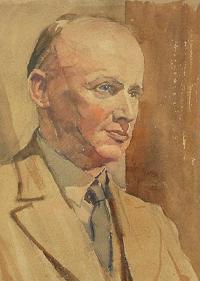
James Patchell Chettle. Portrait by fellow Manchester Academy member Mary McNicoll Wroe (1861-1955).
Introduction
This feature came into being during research for another web project entirely: the life and times of John Cassidy (1860-1939), Manchester sculptor. In 1922-3 Cassidy created a bronze statue and two plaques for the war memorial in the town of Stourbridge, Worcestershire, the overall design of which was by Ernest Pickford of the Bromsgrove Guild of Applied Arts. The resulting article can be read on the John Cassidy website.
Looking further into the life of Ernest Pickford, I discovered that he had lived for many years in the Davenport area at 19 Hazelwood Road, Woodsmoor, and while reading his December 1944 obituary I found, by sheer coincidence, on the same page of the Stockport Advertiser, an obituary for James Chettle, a painter, who also lived in Davenport and had a significant reputation in his day.
Maybe it is time that some recognition was given to people who, although not born in Stockport, chose to make the town their home for the prime of their lives. Here is one of them.
- Charlie Hulme, January 2018.
James Chettle: an Appreciation.
by 'W.M.R.' from the Manchester Guardian.
[William Maxwell Reekie (1869-1948) was a fellow member of the Academy, and a friend of Chettle, also a businessman in the textile industry.]
His subjects were mainly landscapes, both in oil and watercolour, and his favourite subjects were the uplands of Derbyshire and the low-lying marshes of Suffolk. No fewer than fifteen public galleries have bought examples of his work. They include Manchester, Salford and Stockport. He had several one-man shows, notably one of watercolours at Salford Art Gallery two years ago.
There was no art institution in the the district which had not his support, and he was chairman and later president of the Royal Manchester Institution. He was in 1934 President of the Manchester Academy of Fine Arts.
He was a man of kindly and sympathetic nature, especially towards his brother painters. All that he asked for was sincerity, and I remember him telling a young artist, who had described to him the subject he had chosen for his next work, "Yes, that should make a good picture, especially if you can put into it something of the pleasure you felt when you selected it."
One-Man Show by Cotton Trade Artist
Dundee Evening Telegraph, 30 September 1938
Known to Manchester as the man in the cotton trade who does a bit of painting, and to the rest of the country as a distinguished artist, Mr James P Chettle held his first one-man show at Manchester Academy of Fine Arts in Acomb Street to-day.
For years Mr Chettle has been adding to his reputation as a painter, particularly of Derbyshire, which he knows well, and this exhibition of 50 drawings and paintings includes some particularly fine oils of the Derbyshire Countryside.
His work is to be found in permanent connections up and down the country, and he is a member of the Royal Society of British Artists.
Mr Chettle is head of the firm of James P. Chettle Ltd., merchants, of Brazil Street, and it was the chance visit of a well-known painter to his office just after the war that set him painting. On the wall were one of two water-colour sketches, and Mr Chettle was advised to send them to a Manchester exhibition. They were accepted and hung. Mr Chettle has painted ever since.
'These Business Men Turn to Art'
Manchester Evening News, 27 January 1939
What do the men of Manchester's Big Business do with their spare time? Some start work again to relax. Others ... devote themselves to hospital work.
You will find all the clues at the Manchester Art Gallery. They are hung on the walls, and form part of the Manchester Academy of Fine Arts Spring Exhibition. which will open next Thursday.
The exhibitors are all members of the Manchester Academy of Fine Arts, the president of which is James P. Chettle. He has a share in Lancashire's cotton trade and
runs his own business in Manchester.
Derbyshire is the secret of his success as a painter. "my husband loves the hills," Mrs Chettle told me today. "And as we spent the early part of our lives in Derbyshire I think that mus be the reason why so many of my husband's paintings feature scenes there."
Other business men - artists, Mrs Marion Broadhead, secretary of the Academy, told me today, get their inspiration from their travels. Either they paint at home or in studios.
There are 343 pictures and pieces of sculpture in the exhibition. The majority have been done by members of the Academy, all of whom live, or have lived, withing an area 25 miles round Manchester, or have Manchester connections.
The Academy is proud that among its members are Francis Dodd, R.A. and A.R.A.'s Charles Cundall and T.C. Dugdale.
New Mills Petty Sessions, 1902
(Reported in the local press)
There was an interesting case in which Mr. James Chettle, a gentleman living at Mellor, was summoned for keeping a ferocious dog. The prosecution was undertaken by the police, to whom the case had been reported by the Post Office authorities. Miss Hannah Wild, a letter carrier, was attacked by the dog, a large St. Bernard, who flew at her and bit her. It had attacked her on a previous occasion, when the defendant paid her doctor's bill and also the damage to her clothing. It had on one occasion attacked and bitten a neighbour named Frank Clayton, who had fetched a doctor to the defendant when he was ill, and the doctor ran round the corner. (Laughter.)
The defendant expressed regret, and said the dog was a very valuable pedigree animal and generally quiet. He had since kept it chained up, and had a letter box placed on his outer gate. The Bench made an order for the dog to be kept under proper control. and the owner to pay the costs.
Catalogue
Some paintings by Chettle owned by local galleries (not normally on display, unfortunately)
Manchester Art Gallery:
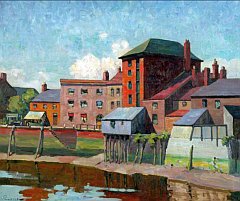
'The Grain Warehouse' (1931)
'Sharpness' (1934)
'Early Morning, Poole Harbour' (1937)
'Pulteney Bridge, Bath' (1938)
'Green Door, Wareham, Dorset' (1940)
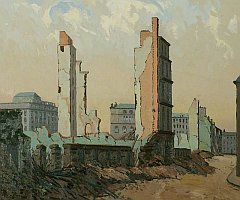
'War Memorial, Manchester' (1941)
In 1941 he took to painting the devastation in Manchester brought about in December 1940 by German bombing. This stark landscape 'War Memorial' shows ruins on Major Street, close to his former workplace which survived the bombing. The warehouses in Portland Street can be made out in the background.
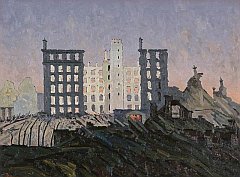
'Bloody but Unbowed (Portland Street, Manchester)' (1941)
Chettle wrote 'I have tried to express more than a mere record ... is it too much to hope that no further subjects of this kind will be presented to us?'
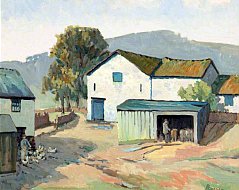
'A Derbyshire Farm' (1941)
'Green Pathway' (1942)
Salford Art Gallery
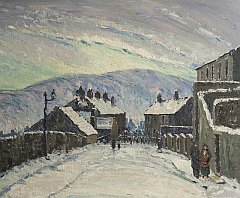
A winter evening, Derbyshire (1938). Donated by the artist in 1942.
Stockport Art Gallery
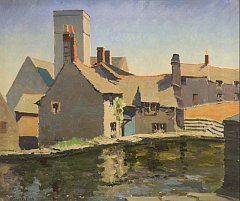
Old Swanage, Dorset (1936)
Above the Valley (1943). This large oil painting (see main text), which was presented by Stockport native and cotton agency owner Fred Beech, was included in an exhibition of landscape paintings entitled 'This Green and Pleasant Land' at Stockport Art Gallery which ran from October 2011 to 1 June 2012; a rare chance to view a Chettle painting in Stockport, along with works by other Manchester Academy members including J.Anderson Hague (The Coast near Deganwy) and R.G. Somerset (A Waterfall).
Works from the Artuk collection are reproduced here under the terms of the Creative Commons Attribution-NonCommercial-NoDerivatives licence.
If you know of Chettle paintings in other galleries or collections, please contact us.
Davenport in 1944
December 1944 was a traumatic time for Davenport, as well as for the Chettle and Pickford families. On Christmas Eve, just a few days after James's death, the horror of airborne warfare reached our quiet suburb. A V-1 flying bomb launched from a Heinkel bomber over the North Sea landed in Garner's Lane, destroying two houses and damaging many others; one man died following the attack and many people were injured.
At the time, the garages on Oakfield Road were in use for the the maintenance of US Army vehicles, and American soldiers were among those who were soon on the scene to help.
One man who lived nearby and died some time after the attack (although it was reported that he was already ill) was 75-year-old Joseph Briscoe, who back in 1907 had been listed in a Stockport street directory as a 'contractor' and tenant of 'The Cottage.'
References
Sheila Dewsbury. The Story So Far: The Manchester Academy of Fine Arts from 1859 to 2003. Manchester: The Academy, 2003.
Shelley Rohde. L.S. Lowry, a biography. Salford, Lowry Press, 1999.
Peter Davies. A Northern School: Lancashire Artists of the Twentieth Century. Bristol: Redcliffe Press, 1989.
Peter Davis, StockpART: 100 Years of putting ART into Stockport. Stockport: Stockport Art Guild, 2019.
Obituary. Stockport Advertiser, 29 December 1944, p.4.
Obituary. Manchester Guardian, 22 December 1944, p.7.
Manchester Academy of Fine Arts website
Census records at www.ancestry.co.uk
Street directories in Stockport Heritage Library and on our site,
Special thanks to Peter Davis, Stephen Lowe, Brian Lorking and Harold Rickson.
This feature is also available as PDF download
Note on copyright: Rights in the works reproduced here remain with the owners. If any owner objects to their inclusion on this wholly non-commercial website, please contact me and they will be removed.
Contributions are very welcome at at davenport.nwrail.org.uk
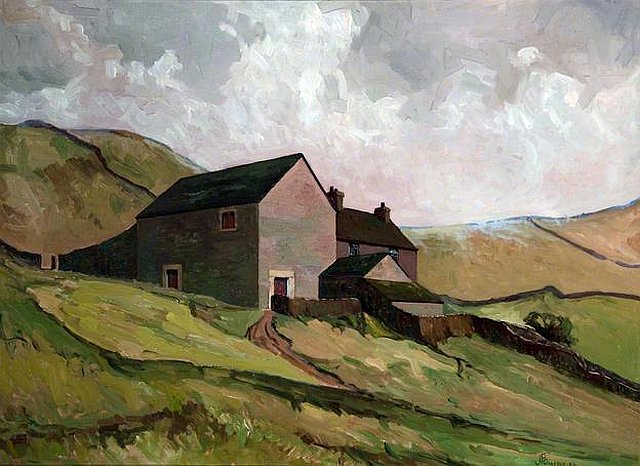
'Solitude' (1932). © Atkinson Gallery, Southport.
James Patchell Chettle was born in 1871 in Sale, Cheshire, the son of Arthur Beecham Chettle and his Liverpool-born wife Esther. In 1881 the family was living in Moss Side, and Arthur was working as a Corn Chandler. By 1891 Arthur had a new profession, traveller [salesman] in woollen cloth, and the family home was 137 Didsbury Road, Heaton Norris on the outskirts of Stockport. James was an apprentice in a warehouse.
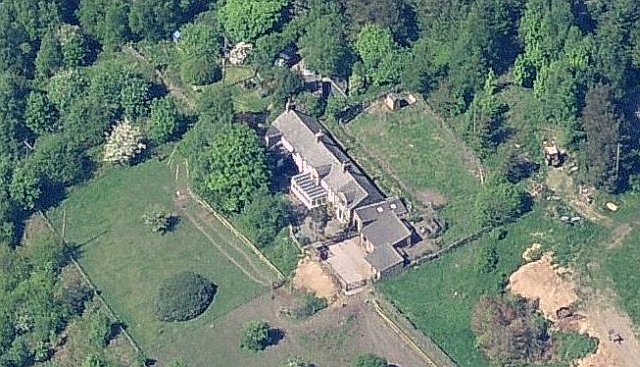
The 1901 census tells us that James, now a time-served warehouseman, had just found himself a wife, listed as Nellie H Chettle, just 18 years old, and the couple had made their home with a domestic servant, Annie Clayton in 'Tor Top', a house in the remote hamlet known as The Banks, on the slopes of Cobden Edge, part of the Derbyshire village of Mellor. Perhaps it was here that he took up painting as a hobby, inspired by the views of the Peak District hills. Perhaps he travelled to work by walking the couple of miles down to Strines Railway station. His wife 'Nellie' was born Eleanor Hewson Beck in West Derby, Liverpool, daughter of a Scottish-born draper, Thomas Beck, and his wife Susan. A record from 1909 has them at 'Peniche', Buxton Road, Disley, somewhat nearer a railway station.
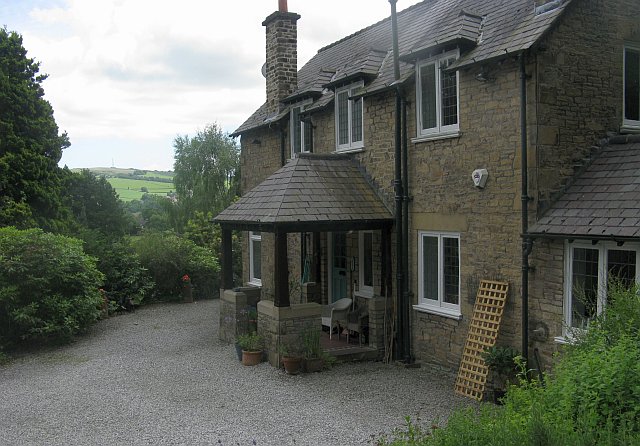
James flourished in the busy Manchester cotton trading market of the time; by 1911 he was described as 'Manager of White Cotton Merchant' and was living at 'Craigside' (above), a large house in a picturesque setting above Reservoir Road in the village of Whaley Bridge. Again on the edge of the Peak District, the house with its one-acre garden and sought-after view across Toddbrook Reservoir, and for James an easy walk to Whaley Bridge station. Like 'Tor Top', 'Craigside' cannot be seen from the public road; our picture was taken in 2017 during a charity garden open day.
An extended family lived with James and Eleanor in the five-bedroom house: two daughters, mother-in-law, sister-in-law and niece. According to his obituary, it was around this time, aged 42, that he began to 'take the work [of painting] seriously.'
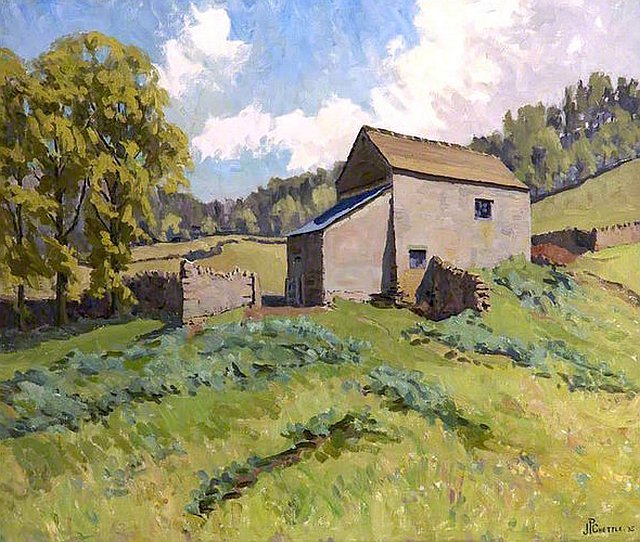
'On a Hillside' (1936)
Despite the disruption caused by the First World War, the Chettle family continued to flourish. By 1921 the family had re-located to Davenport, living in 'Wythburn', Davenport Park Road, and by 1923 James was in business at 29 Major Street, Manchester as a 'buying agent.' Soon afterwards the family moved again, this time to 'The Cottage' - a detached house with a large garden - in nearby Clifton Road (known today as Clifton Park Road) where they were to remain for many years. His office address became 52 Mosley Street (the building which houses on its upper floor the Portico Library), and by the 1930s, 1 Brazil Street, Manchester. After the War, he served on the committee which created the Stockport War Memorial Art Gallery, where he later exhibited paintings on many occasions.
James's only son, born in 1914, was also named James Patchell Chettle (so the firm would be able to keep the same name) and to avoid confusion became known in the family as Peter. By 1939 he was a director of the firm. He married Molly Robinson, of Dial House, Bramhall in 1939 and they made their home at 5 Elswick Avenue, Bramhall. During the War he served in the Royal Signals Regiment, while Molly worked for Air Raid Protection as an ambulance driver. He lived until 2007.In 1927 James (senior) joined the Manchester Academy of Fine Arts, which had been founded in 1859 as an association of professional artists, but has recently begun to admit non-professional artists. He was elected a full member of the Academy in 1930 and, the Stockport Advertiser obituary records, 'his rise to fame as an artist was 'meteoric.' In 1933 he was elected as vice-president of the Academy, and in 1934 became the first non-professional artist to be President. No doubt his business acumen was as welcome to the members as the quality of his paintings, in the difficult years that followed; he remained president until his death. He also served as President of the Manchester Athenaeum Graphic Club, where he himself had learned his art.
He sold many paintings to private collectors and public galleries: Manchester Galleries own several, although you'll be lucky to see one on display. His regime at The Academy was the subject of some controversy, as professional painters with 'modern' ideas felt that their work was being given second place to traditional figurative work such as Chettle's landscapes. In 1938, at the Academy's studios in Acomb Street, Rusholme, he exhibited 50 of his paintings.
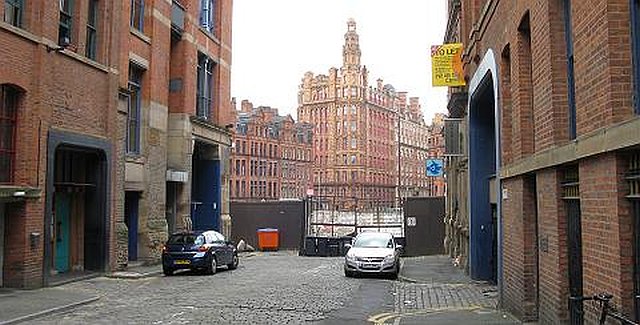
In 1937, the firm of J.P.Chettle Ltd, wholesalers of textiles, was incorporated, based at the 1 Brazil Street headquarters (the building on the right of the present-day picture above) although at some time a additional London office was opened.
James and Eleanor moved to a large 1930s-style house at 1 Ramsdale Road, Bramhall, where in December 1944 James died. In September - October 1945 a Memorial Exhibition of his work was held at the City Art Gallery, transferring to the Manchester Graphic Club.
Eleanor remained at Ramsdale Road, outliving her husband by many years, later moving to 17 Hartington Road, Bramhall. She died in 1976 in Horsham, Surrey. James P. Chettle Ltd was eventually sold to Frederick John Macer, the company's London agent, who re-located the firm Mansell Street in London. On his retirement in 1983 the firm was sold on to Brian Lorking who combined it with his own firm, Textile House Ltd. based in Suffolk.
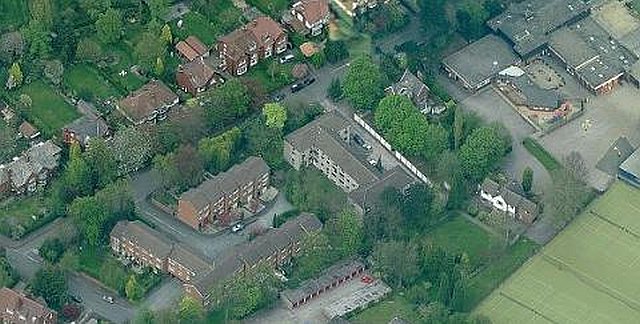
'The Cottage', where James Chettle made many of his paintings, no longer exists, having met the fate of most of the largest 'villas' built in Davenport in Victorian and Edwardian times and unwanted by later generations. It was demolished in the 1960s, long before Davenport Park was designated a 'Conservation Area' - replaced by 'Clifton Lodge', the grey 'H-block' seen in centre of the the current aerial view above, which contains eighteen separate apartments. Of the seven houses which once stood on the south side of the road, nearly all have disappeared, although the smaller ones on the north side are all still intact.
An earlier resident of 'The Cottage' was William Henry Lees, Felt Hat Manufacturer, whose father, William Lees, with his brother Thomas, is said to have begun making hats at their home in Reddish at the age of eight. The brothers later developed one of Stockport's largest hat factories in Adcroft Street, off Hillgate.
Chettle and Lowry
One of the first artists to be invited to become members of the Academy under Chettle's presidency became one of its most famous members: Laurence S. Lowry. Like Chettle, Lowry also had a full-time job, but unlike Chettle, this fact was not generally known for many years. However Chettle was artistically very different from his friend Lowry.
In her biography of Lowry, Shelley Rhode relates:
James Chettle, a man with inordinately large red ears who painted pleasant watercolours, came eventually to be regarded by Lowry with some affection despite his unhappy knack of the saying the wrong thing at the wrong time ... there was a tale, told by Lowry ... that at the opening of an exhibition at Salford City Art Gallery, Chettle was heard to remark that he had in his breakfast room a drawing of Lowry's ('which I gave him', Lowry interjected) with a cat in it that looked like no cat on earth. Lowry, seated just in front of the speaker, barely turned his head to observe, quite distinctly: 'It's a dog.'Chettle, along with another local artist, Frederick Davenport Bates, was involved with the Stockport Art Guild, initially named the Stockport Guild of Arts and Crafts, which celebrated its centenary in 2019. In 1927 he joined of the committee which managed the Stockport War Memorial Art Gallery, and for the next years was responsible for selecting and approving works for the gallery's permanent collection, possibly explaining why the collection includes a number of his works. It is said that on on one occasion the Committee paid more for a Chettle than for a work by L.S. Lowry.
In his footsteps
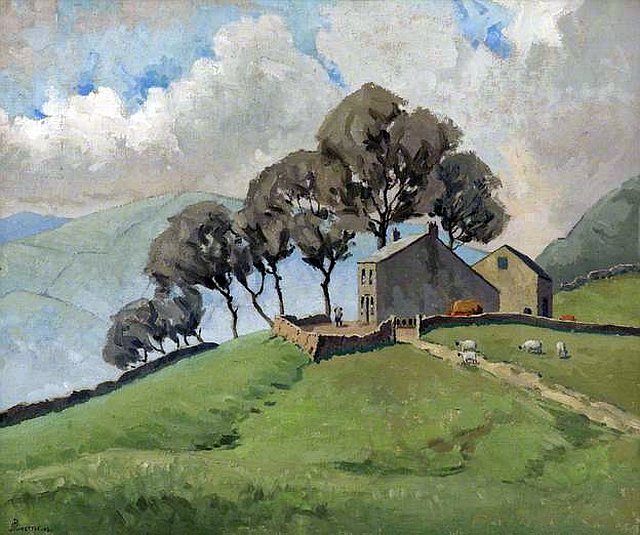
In 2011 we explored the Cobden Edge area on foot, with a view to experiencing some of Mr Chettle's inspiration and perhaps finding his old house. We had in mind 'Above the Valley' although it was one of his last works, painted long after he moved house from 'Tor Top'.
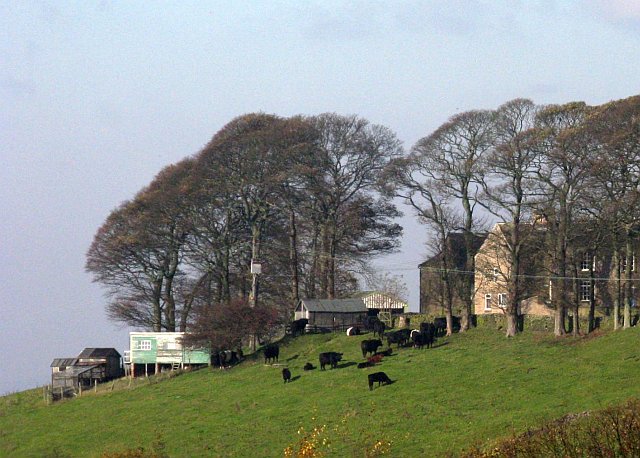
Here's our photographic effort.
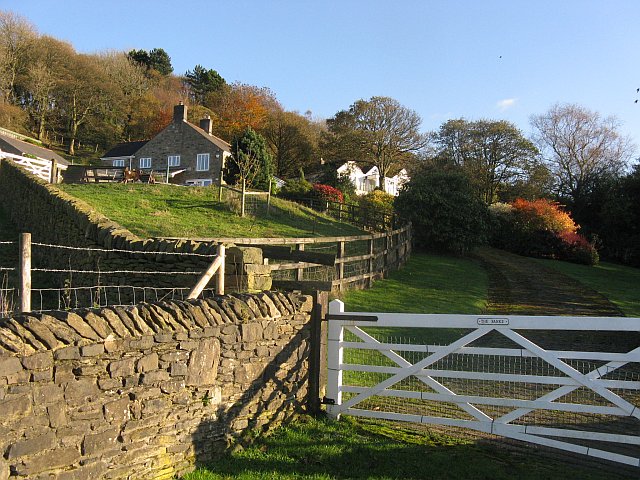
As we mentioned above, we did not reach 'Tor Top' itself, not wishing to pass this gate leading to The Banks. The house is behind the trees in the right distance.
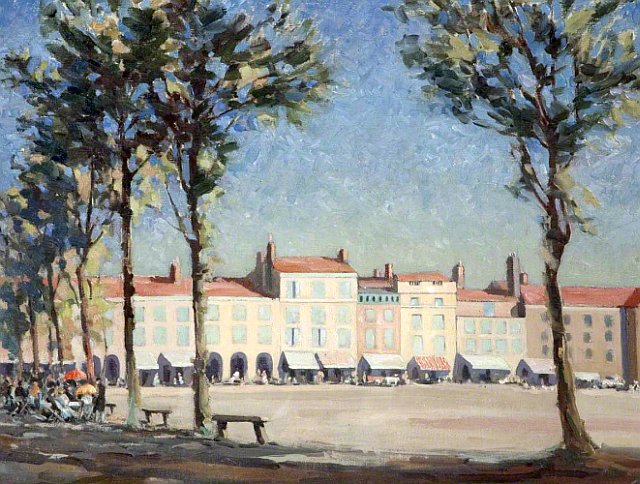
Soon after creating this feature, having seen 'Place Verdun, La Rochelle' (1929) which is owned by Blackburn Art Gallery, we were inspired to spend a few days in La Rochelle ourselves...
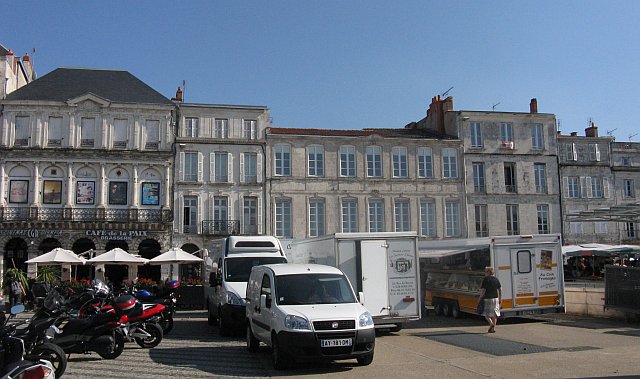
... and a very pleasant holiday we had. Unfortunately, Place Verdun is a little more crowded today than when the Chettles holidayed there.
Gallery
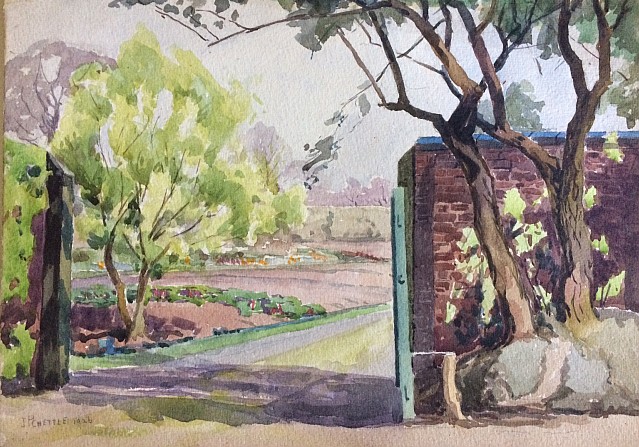
As a result of this feature, a number of readers, including relatives of the Chettle family, have sent us images of works they own. This watercolour, signed and dated 1926, has been handed down the family to Chettle's maternal grandson.
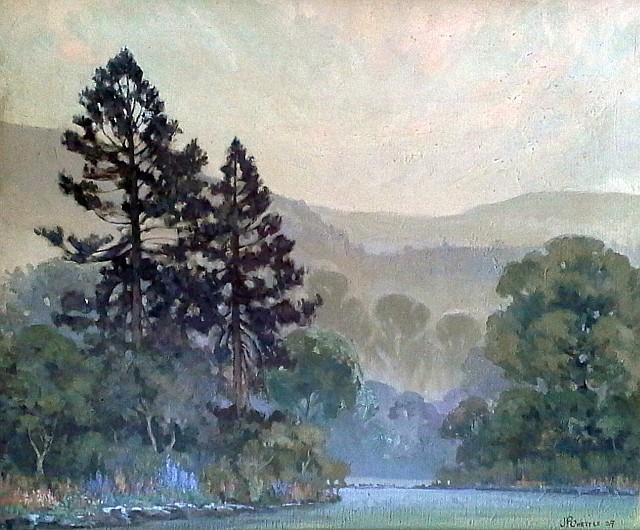
This work is from 1929. This landscape with trees and hills in the background is said to be based on the artist's garden in Clifton Park Road, Davenport Park, with the Derbyshire Hills brought closer.
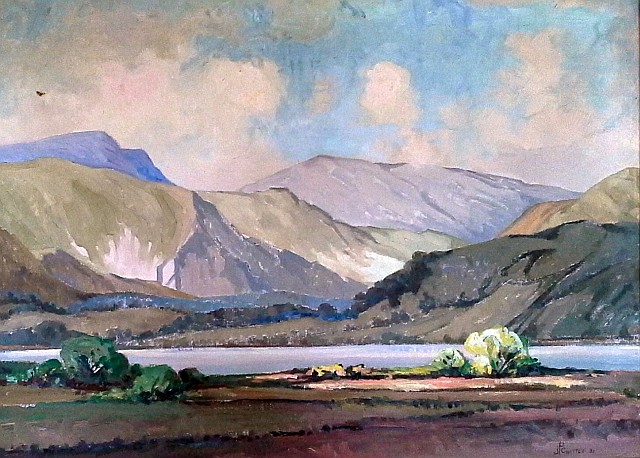
'Glen Falloch' (1931).
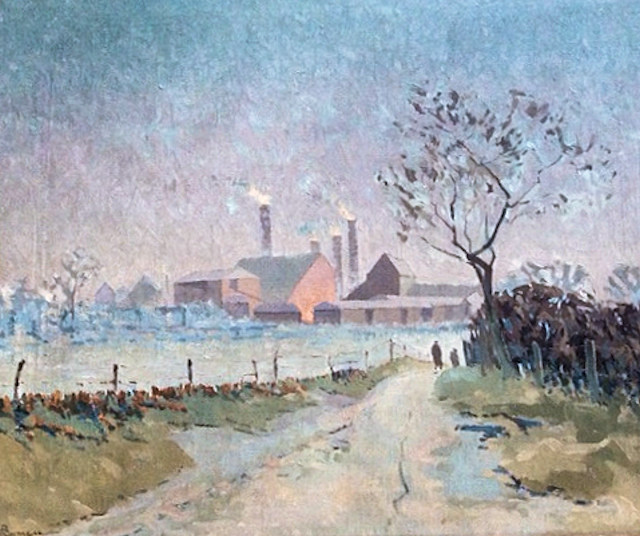
This and the two pictures below hung in the company offices.
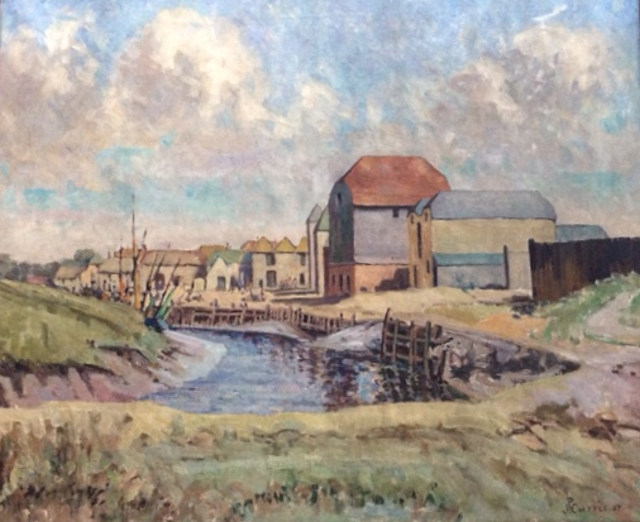
Possibly scenes from his holidays in Suffolk.
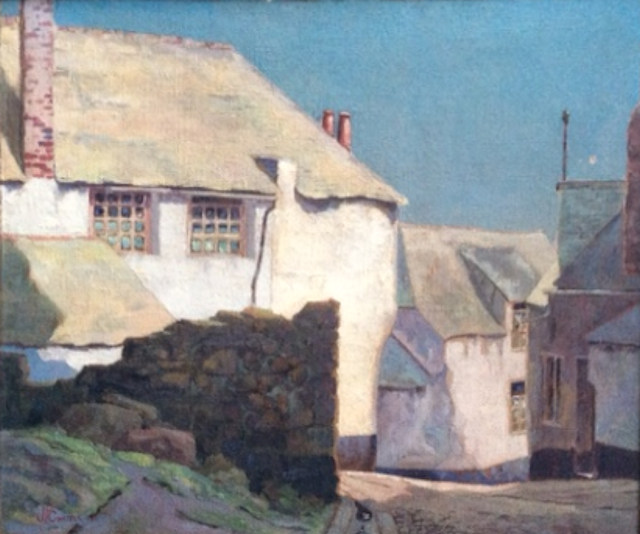
A Suffolk hill village, perhaps Kersey.
Written by Charlie Hulme, July 2011. Last updated August 2021.